Main branch: definition and example
A main branch is a topic attached directly to the central topic of a mind map, and it heads one major part of the subject with its own subtopics below it.
What it means
Main branches are the first split of the subject. Together they should cover most of what the central topic contains, and each should stand for one kind of thing, such as one phase, one cause or one chapter.
How many to use
Four to eight is a common range. Fewer can mean the subject is not yet broken down. A lot more usually means two levels have been mixed together, so some of them should move under another branch as subtopics.
How it differs from nearby terms
A main branch is one level below the central topic and one level above its subtopics. In the editor it may be coloured, so the branches can be told apart on a large map.
Try it
The project plan template is a map with branches for goals, people, timeline and risks that you can open and edit.
Example
In a map called "Weekly plan", the main branches might be Work, Health, Home and Learning. Under Health, the subtopics are three runs, two gym sessions and a doctor's visit.
Related terms
- Central topic: The central topic is the single topic at the middle of a mind map, the subject that every branch and subtopic in the map belongs to.
- Subtopic: A subtopic is a topic placed under another topic in a mind map, holding one detail, example or part of the idea above it.
- Mind map: A mind map is a diagram that puts one idea in the centre and arranges related ideas around it as branches, with the details of each branch nested under it.
- Summary topic: A summary topic is a topic joined by a bracket to a range of sibling topics in a mind map, giving a single conclusion or label for the whole range.
See it in a template
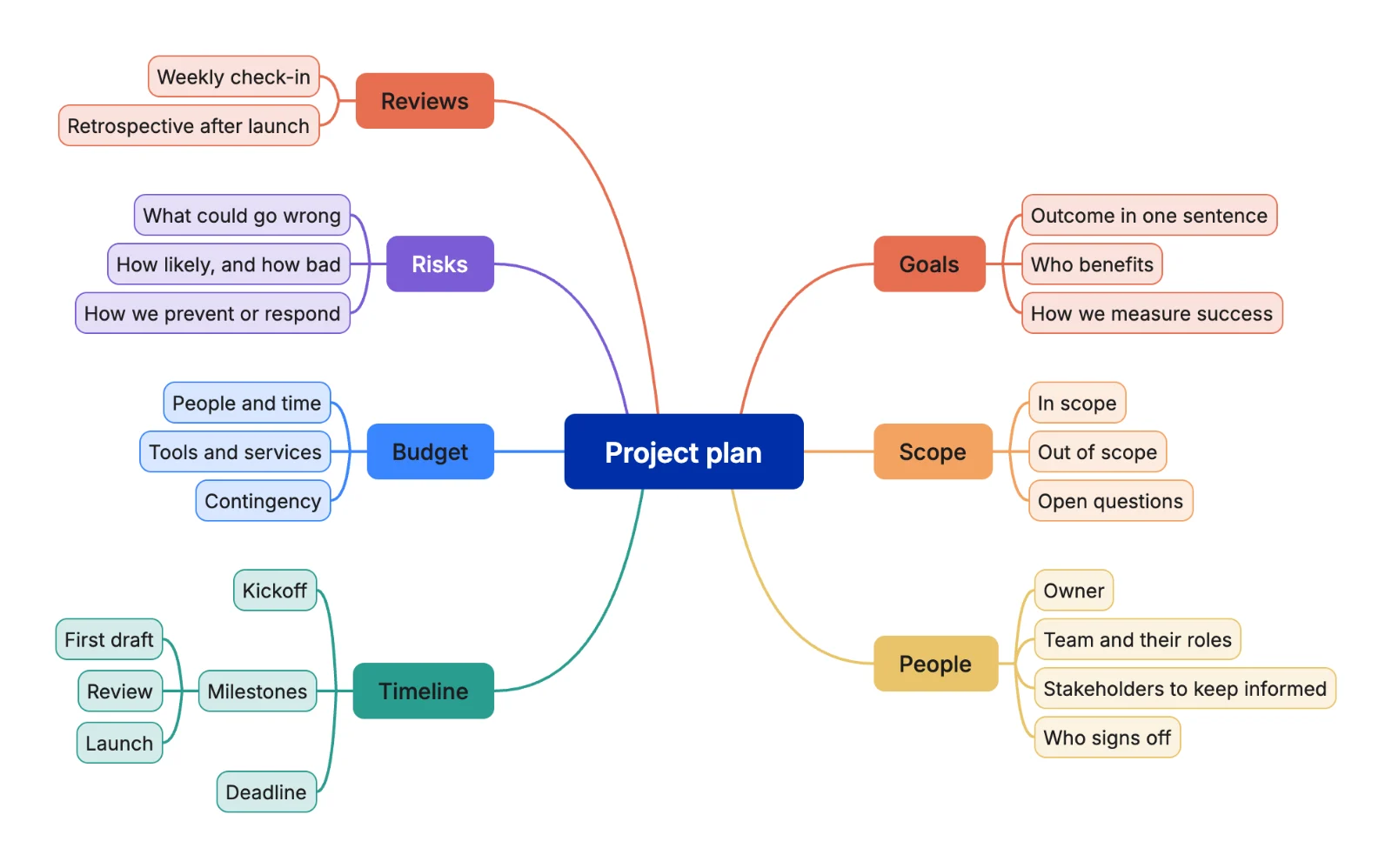 Project plan mind map template