Brace map: definition and example
A brace map is a diagram that shows a whole on one side and splits it into parts and sub-parts with curly braces, usually reading from left to right.
What it means
The brace map answers one question: what are the parts of this? Each level is a part-whole split, so it is best for things that really are made of components.
When to use one
Use it for anatomy, structures, categories and the sections of a document. It is less suited to causes, steps in time or loose brainstorming, where the links are not part-whole.
How it differs from nearby terms
A logic chart has the same left-to-right shape but joins children with lines, so it works for any topic. A summary topic uses one bracket to state a conclusion over some siblings. A tree chart runs downward.
In MindmapPal
The MindmapPal app for iPhone and iPad has the brace map as one of its structures, in a left and a right version. The essay outline template opens in the web editor as a brace map, a good start for splitting an essay into its parts.
Example
A bicycle sits at the left. A brace leads to frame, wheels and drivetrain. A second brace from wheels leads to rim, spokes, hub and tyre.
Related terms
- Logic chart: A logic chart is a mind map structure in which the central topic sits at one side and every branch extends in a single direction, so the map reads from left to right or right to left.
- Tree chart: A tree chart is a diagram of a hierarchy in which one root splits into branches, which split again, drawn in a vertical or horizontal layout.
- Summary topic: A summary topic is a topic joined by a bracket to a range of sibling topics in a mind map, giving a single conclusion or label for the whole range.
- Mind map: A mind map is a diagram that puts one idea in the centre and arranges related ideas around it as branches, with the details of each branch nested under it.
See it in a template
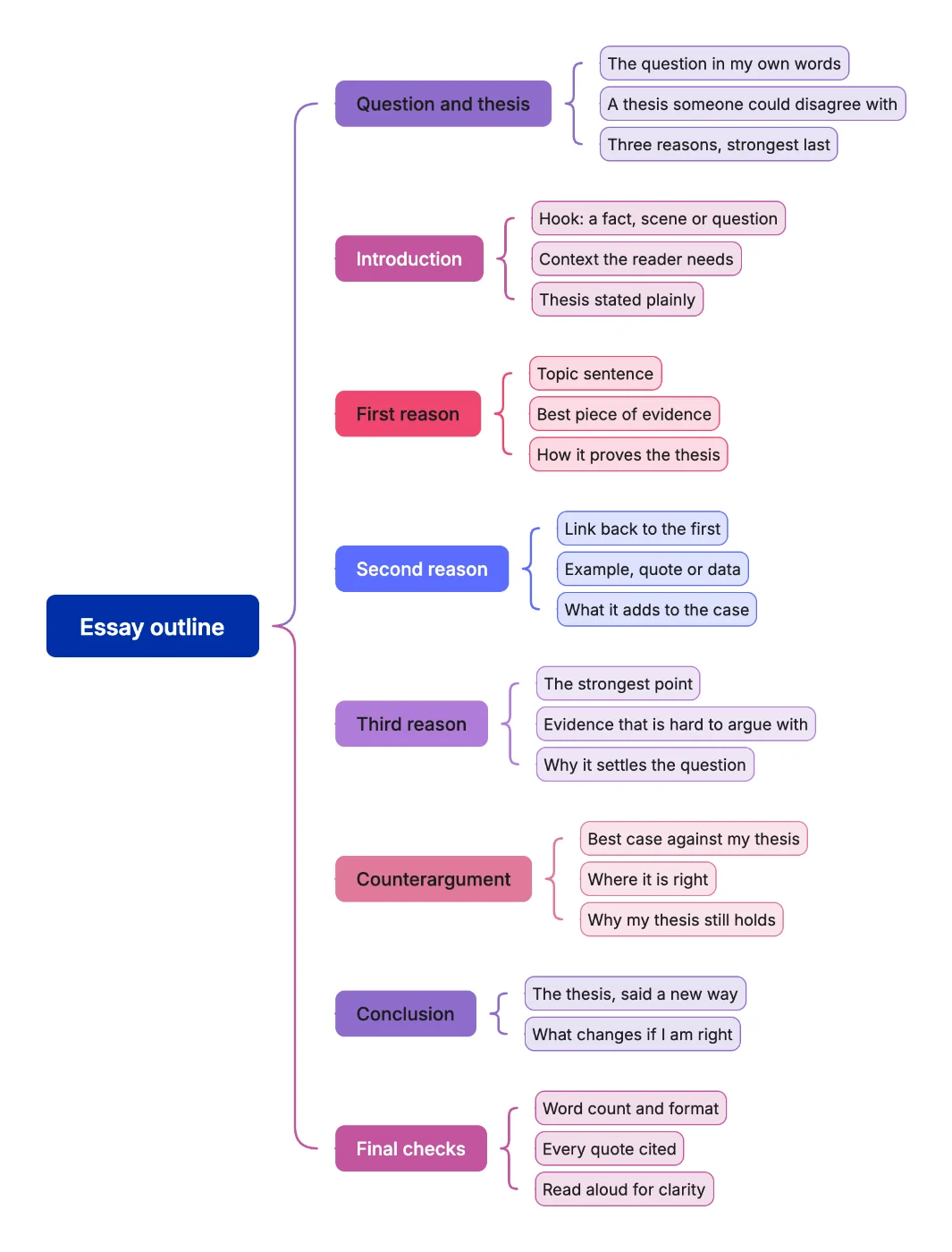 Essay outline mind map template