Tree chart: definition and example
A tree chart is a diagram of a hierarchy in which one root splits into branches, which split again, drawn in a vertical or horizontal layout.
What it means
“Tree” here means that each item has exactly one parent. Nothing links sideways, which makes the chart simple and easy to read.
When to use one
Use it for steps from top to bottom, for file structures, menus, and any breakdown where each part belongs to one thing only.
How it differs from nearby terms
A mind map is also a tree, but it is drawn outward from a centre. An org chart draws boxes in rows. A logic chart goes sideways. A concept map is not a tree, because an idea can have many links.
In MindmapPal
The MindmapPal app for iPhone and iPad has tree chart structures in several directions. The trip planning template opens in the web editor as a tree.
Example
A trip plan has the root "Japan trip" at the top. Below it, Tokyo, Kyoto and Osaka each split into days, and each day splits into places to visit.
Related terms
- Org chart: An org chart structure is a layout in which the central topic sits at the top and each level of branches runs below it in rows, like a reporting chart.
- Logic chart: A logic chart is a mind map structure in which the central topic sits at one side and every branch extends in a single direction, so the map reads from left to right or right to left.
- Outline: An outline is a list of items arranged in levels, with each indented item belonging to the item above it, so the whole reads from top to bottom.
- Mind map: A mind map is a diagram that puts one idea in the centre and arranges related ideas around it as branches, with the details of each branch nested under it.
See it in a template
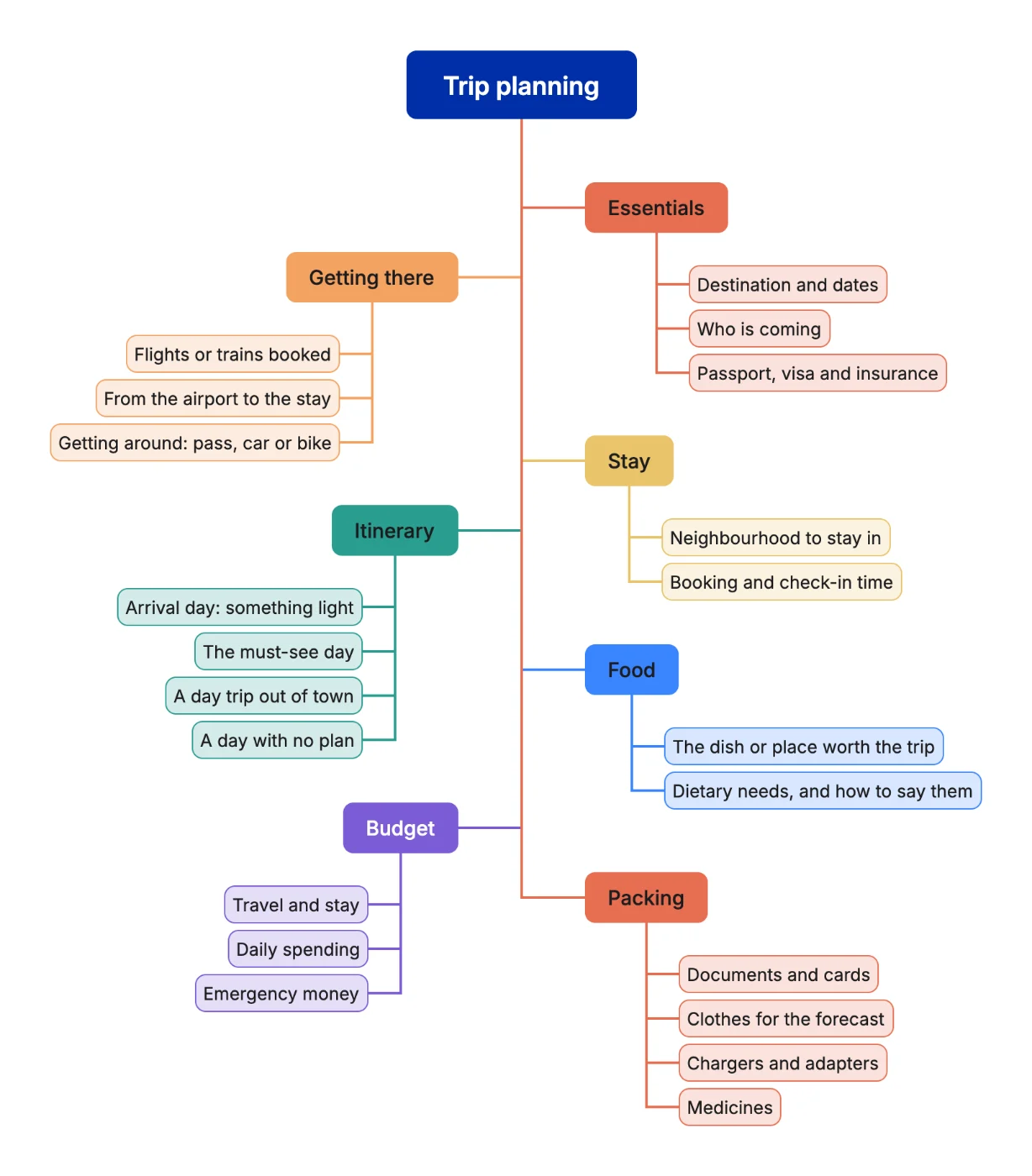 Trip planning mind map template