Radial thinking: definition and example
Radial thinking is the habit of starting from one idea and branching out to every related idea around it, rather than following a single line of reasoning.
What it means
Most writing is linear: one point after another. Radial thinking works outward from a centre, so many ideas can follow from one without being put in order first.
How it relates to mind maps
A mind map is a way to draw this kind of thinking. The central topic is the start, and each branch is one direction the idea fans out in. You can order and prune later.
Limits
Radial thinking helps with generating and sorting ideas. It does not replace deciding. After the fan-out, pick the branches that matter and turn them into an outline or a plan.
Try it
Open the brainstorming template and replace the centre with your own question.
Example
Asked how to improve a website, you write "Website" in the centre and let ideas fan out: speed, content, design, search and sales. Each leads to more ideas.
Related terms
- Mind map: A mind map is a diagram that puts one idea in the centre and arranges related ideas around it as branches, with the details of each branch nested under it.
- Brainstorming: Brainstorming is a technique for producing a large number of ideas on a topic, alone or in a group, before any of them is judged or chosen.
- Central topic: The central topic is the single topic at the middle of a mind map, the subject that every branch and subtopic in the map belongs to.
- Spider diagram: A spider diagram is a diagram with a topic in the middle and related ideas on lines around it, like the legs of a spider, and is closely related to a mind map.
See it in a template
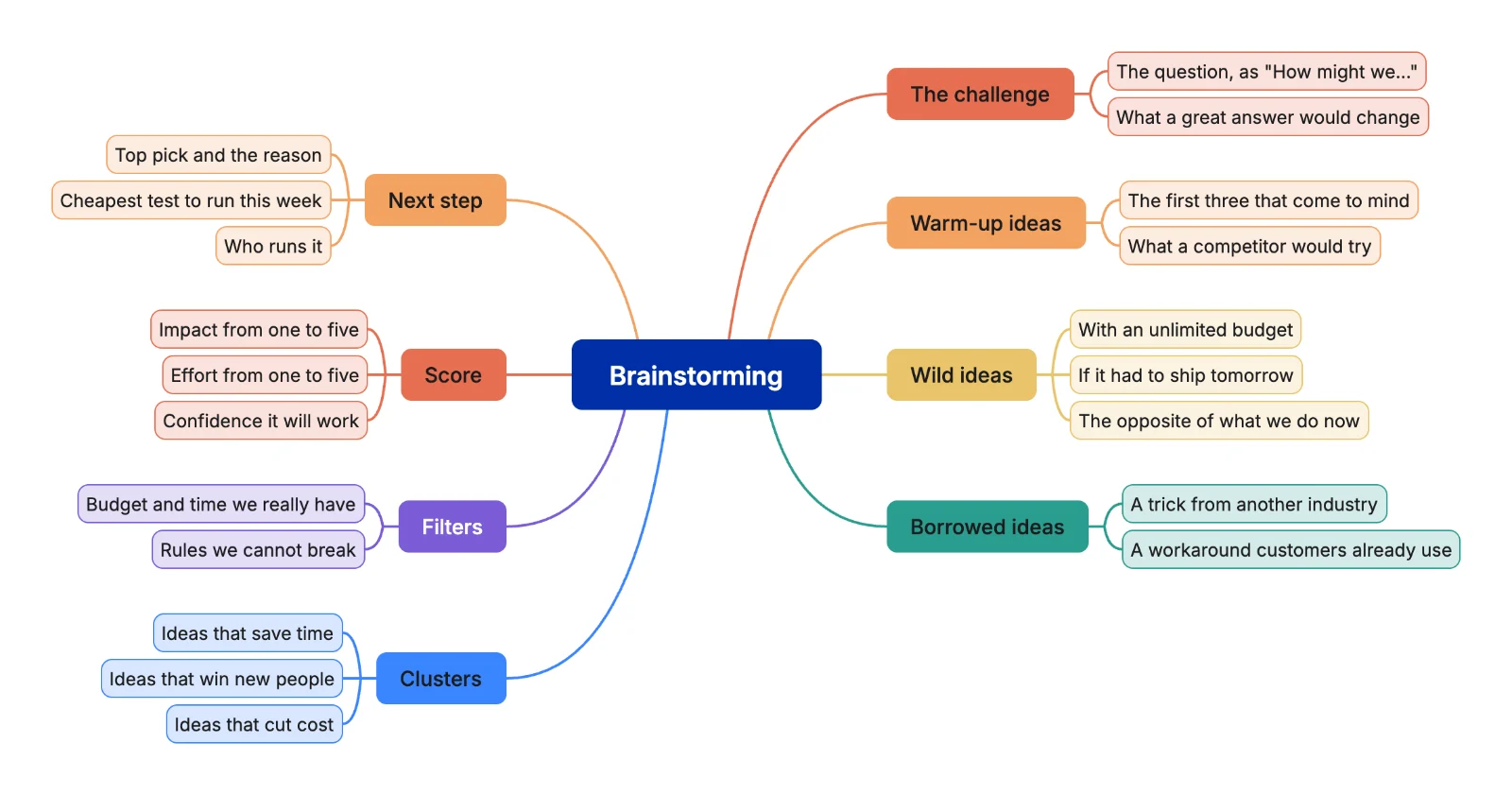 Brainstorming mind map template