Outline: definition and example
An outline is a list of items arranged in levels, with each indented item belonging to the item above it, so the whole reads from top to bottom.
What it means
An outline is a tree written as lines. Each level is shown by indentation or numbering. Word processors, note apps and code editors all handle outlines.
How it differs from a mind map
An outline and a mind map can hold the same content. The outline is linear and good for writing and editing text. The map is spatial and good for seeing the shape of a subject. The guide on mind maps and outlines compares them in more depth.
Moving between the two
An outline can become a map and the other way round. Plain-text formats such as a Markdown outline and OPML carry the levels, so you can draft one way and finish the other.
In MindmapPal
The app has ten structures and lets you switch between the map and an outline of the same content. The web tools turn a map into Markdown and a Markdown outline into a map.
Example
An essay outline lists Introduction, Argument 1, Argument 2 and Conclusion. Under each argument, indented lines give the evidence and the counterpoint.
Related terms
- Mind map: A mind map is a diagram that puts one idea in the centre and arranges related ideas around it as branches, with the details of each branch nested under it.
- Markdown outline: A Markdown outline is an outline written in Markdown, using headings or indented list items so that each line becomes a topic under the line above it.
- OPML: OPML is an XML-based file format for outlines, used by many outliners, feed readers and mind map tools to exchange nested lists of text.
- Logic chart: A logic chart is a mind map structure in which the central topic sits at one side and every branch extends in a single direction, so the map reads from left to right or right to left.
See it in a template
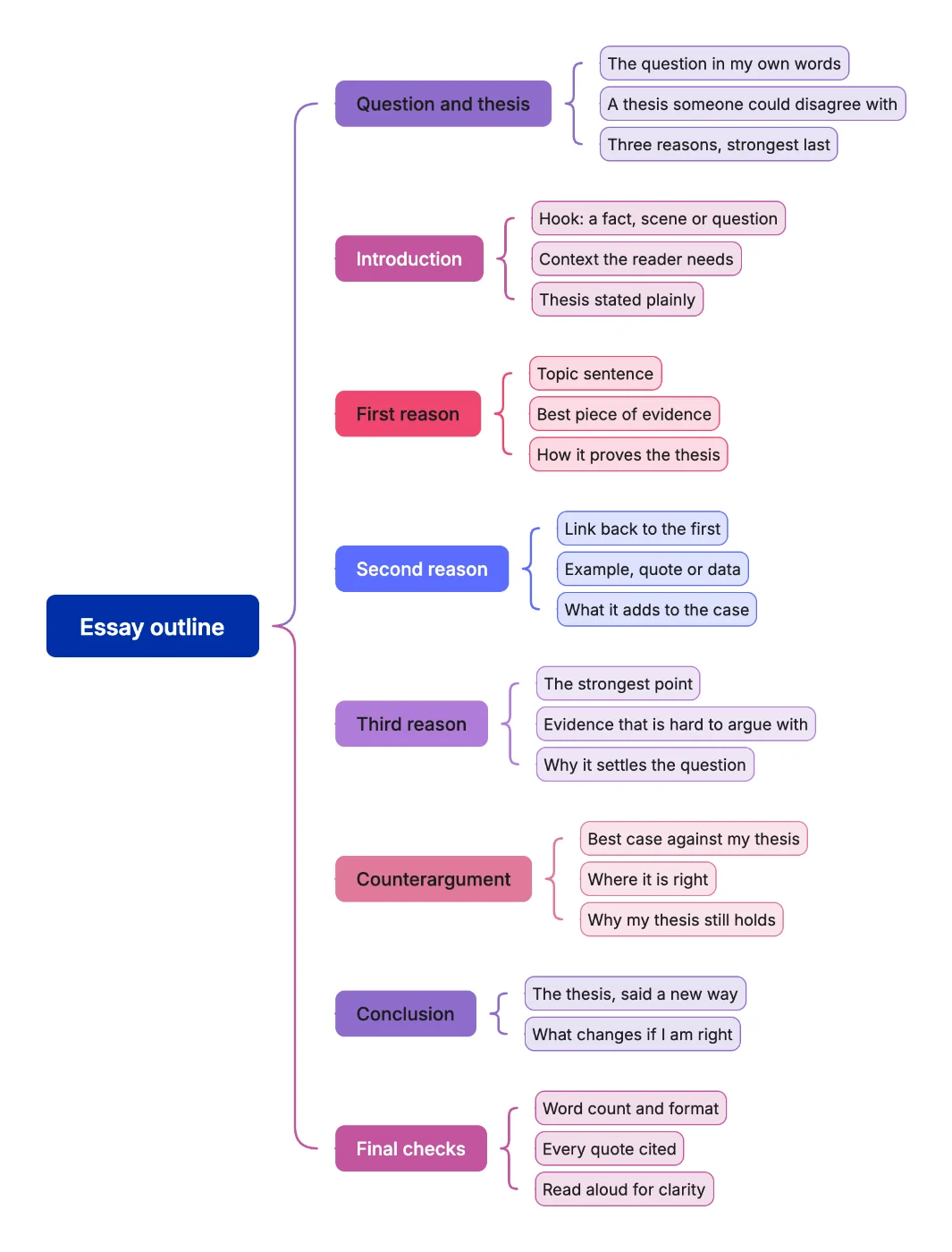 Essay outline mind map template