Knowledge map: definition and example
A knowledge map is a diagram that lays out the topics of a subject or the knowledge held by a person or team, organised so you can see what is covered and what is missing.
What it means
The term is used in two ways. One is a map of a subject, such as a course or field. The other is a map of who knows what in an organisation. Both aim to show coverage and gaps.
How to build one
Put the field in the central topic, make a main branch for each area, and list the specific topics under it. Mark each topic with your level, with markers or colours.
How it differs from nearby terms
A mind map is the form; a knowledge map is a use of it. A concept map focuses on how concepts link, not on coverage.
Try it
The exam revision template is a knowledge map for a course, with branches you can fill in. See also the guide on mind mapping for studying.
Example
A student maps a course with branches for each unit, then marks topics green when understood and red when not. The red ones become the revision list.
Related terms
- Mind map: A mind map is a diagram that puts one idea in the centre and arranges related ideas around it as branches, with the details of each branch nested under it.
- Concept map: A concept map is a diagram of concepts joined by labelled links that read as statements, such as "plants make glucose", and it can be a network with no single centre.
- Main branch: A main branch is a topic attached directly to the central topic of a mind map, and it heads one major part of the subject with its own subtopics below it.
- Outline: An outline is a list of items arranged in levels, with each indented item belonging to the item above it, so the whole reads from top to bottom.
See it in a template
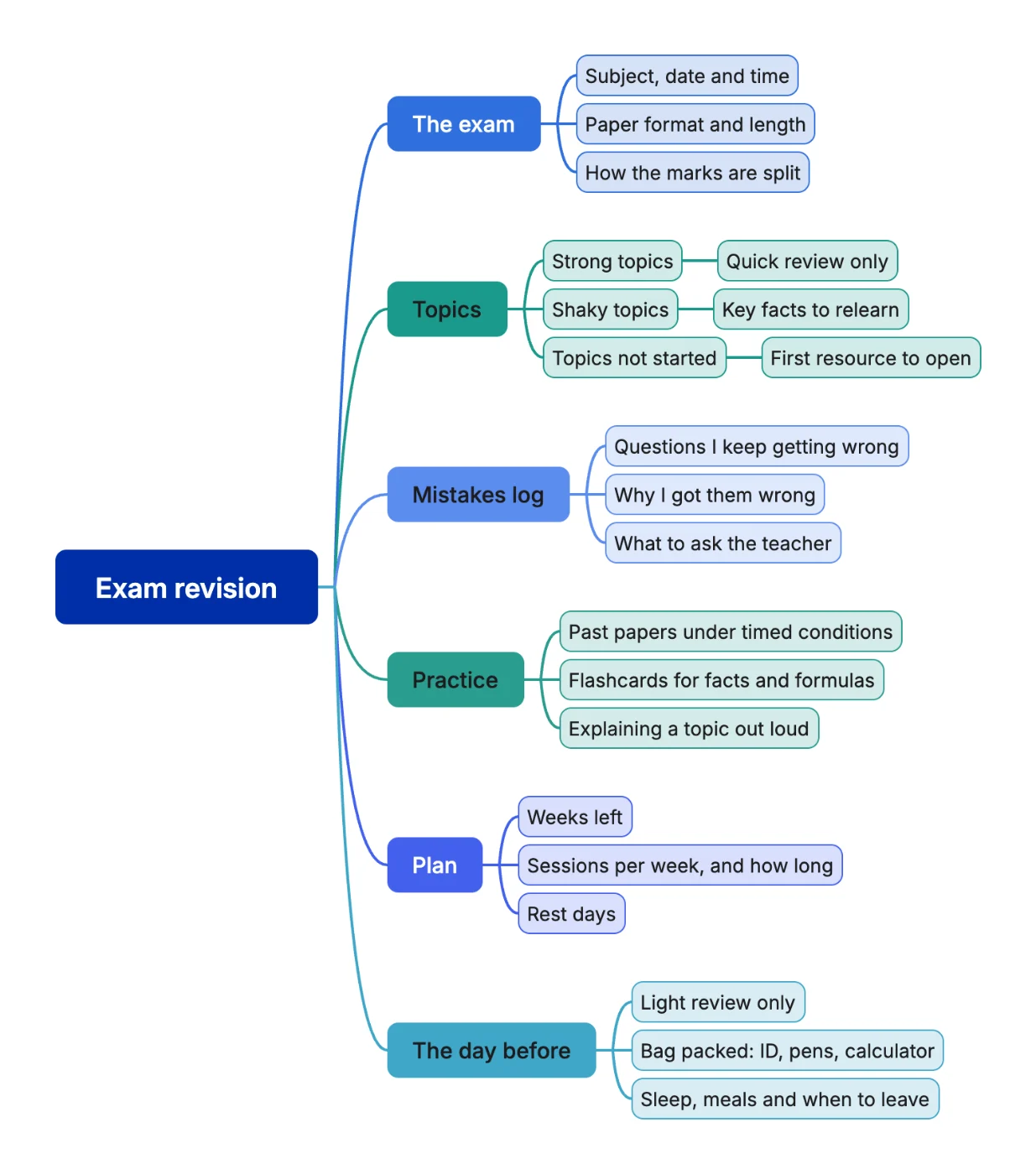 Exam revision mind map template